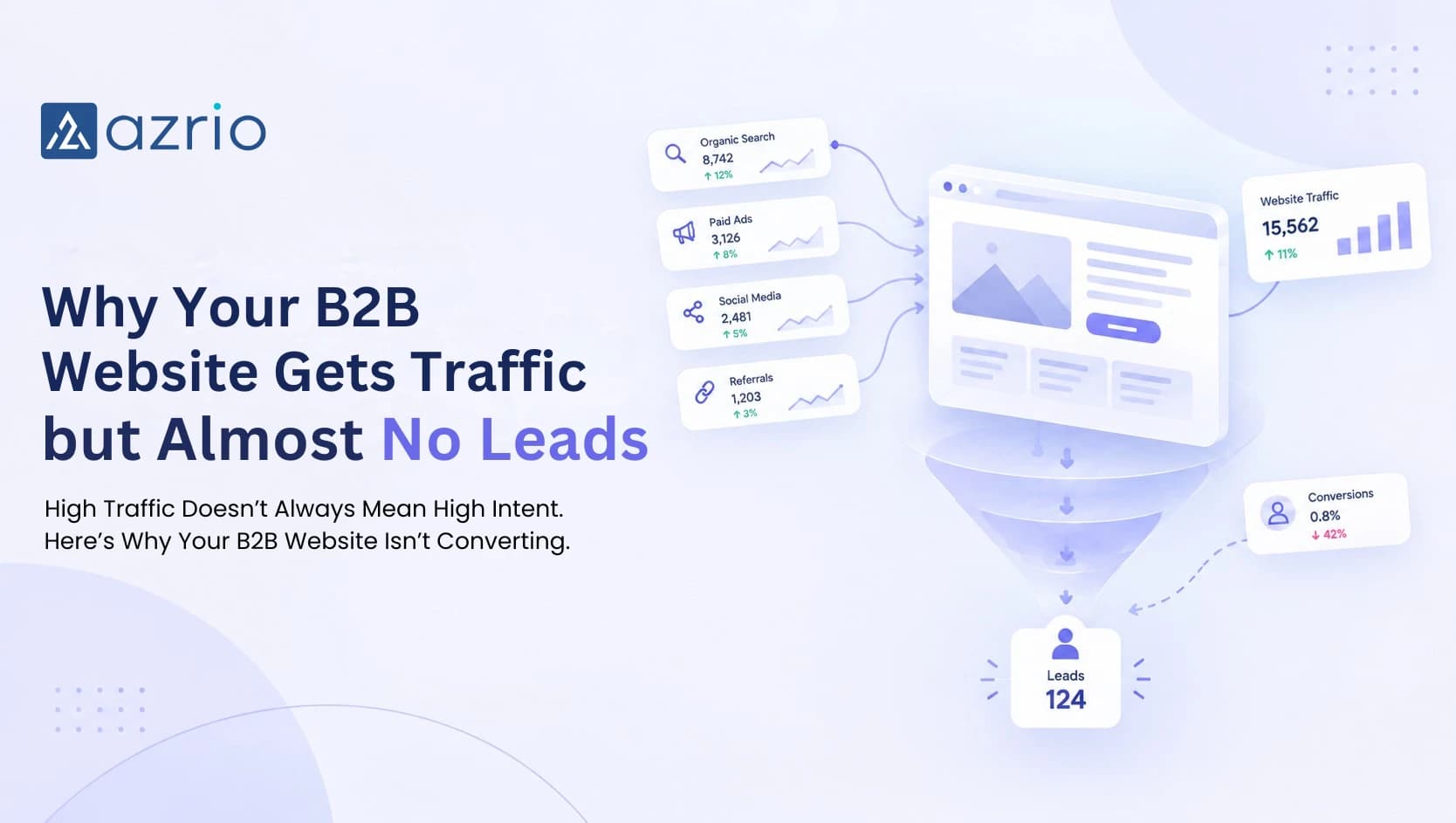
Your website traffic is growing, but your sales pipeline isn't.
The numbers may look good in Google Analytics. Visitors are coming from search, blog posts are getting clicks, and rankings are improving. Yet the contact form remains quiet and qualified enquiries are hard to find.
The obvious response is to chase more traffic.
But what if traffic isn't the real problem?
A B2B website can attract thousands of visitors and still generate almost no leads when those visitors have the wrong intent, the messaging is unclear, or the website gives buyers no compelling reason to take the next step.
For B2B companies, the bigger question is not how many people visit the website.
It is whether the right buyers can move from discovering the company to seriously considering it.
And that journey is where most of the leaks happen.
The 7 Real Reasons Your Website Isn’t Generating Leads
A website that gets traffic but produces few leads usually does not have one single problem. The leak can happen at several points, from the type of visitor arriving on the site to the amount of effort required to start a conversation.
For businesses investing in website development, SEO, and digital marketing, these issues are closely connected. A website needs the right traffic, clear positioning, useful content, and a conversion path that matches how B2B buyers actually research and make decisions.
1. Your Website Is Attracting the Wrong B2B Traffic
More traffic does not automatically mean more opportunities. If the people arriving on the website are outside the target market or have no immediate business need, a low conversion rate is not surprising.
The problem often starts with SEO. Content built around high-volume keywords can bring impressive traffic numbers while attracting very few potential customers. A stronger SEO strategy looks beyond search volume and considers who is searching, why they are searching, and whether that intent matches the business.
2. Your SEO Strategy Targets Searches, Not Buyers
A page can rank on Google and still have little commercial value.
Broad informational searches are useful for building awareness, but B2B buyers also search for solutions, vendors, comparisons, implementation help, and industry-specific capabilities. Those searches often carry much stronger buying intent.
This is why SEO should not operate separately from the website. The content, landing pages, services, and conversion paths all need to support the same buyer journey. A well-planned digital marketing strategy can help connect these pieces instead of treating traffic as the final goal.
3. Visitors Cannot Quickly Understand What You Offer
A potential buyer should not have to read five pages to understand what a company actually does.
Many B2B websites use vague statements such as “digital solutions for modern businesses” or “technology that drives growth.” These sound professional but tell the visitor very little.
A stronger website makes the connection obvious. It explains what the solution is, who it is for, what problem it addresses, and why it is relevant.
This is also where AI-powered web development can add value. Personalised experiences, AI assistants, intelligent content discovery, and integrations with business systems can help visitors find relevant information without making the website more complicated.
4. Your Website Talks About the Company Instead of the Buyer
Company history, capabilities, technologies, awards, and achievements can build credibility. But they should not dominate the first conversation.
A buyer usually arrives with a problem. The website should acknowledge that problem before asking the visitor to care about the company.
For example, a manufacturing business looking for software may care more about production visibility, inventory accuracy, and operational reporting than the development team's technology stack.
5. Your CTA Asks for Too Much Too Soon
“Book a Demo” or “Contact Sales” may be appropriate for someone ready to buy. But not every visitor is at that stage.
Someone comparing solutions may want to see an industry use case, understand how the product works, read an implementation guide, or explore a specific service before speaking to sales.
When every page pushes the same high-commitment CTA, visitors who are interested but not yet ready have nowhere else to go. Better B2B websites give buyers different next steps based on their level of intent.
6. Your Website Does Not Give Buyers Enough Reasons to Trust You
B2B purchases involve risk. The buyer is not only asking whether the solution looks good. They are also asking whether the company can actually deliver it.
That makes proof important. Client examples, relevant industry experience, case studies, product demonstrations, implementation details, technical documentation, and clear answers to common concerns can all reduce uncertainty.
A website that combines strong corporate web development with useful decision-making content can make this information easier to discover. The goal is not to fill every page with claims. It is to give buyers enough evidence to make the next decision with confidence.
7. The Conversion Journey Has Too Much Friction
Sometimes the visitor wants to make contact but the website makes it unnecessarily difficult.
A long form, unclear CTA, slow page, poor mobile experience, missing contact information, or uncertain response process can stop an otherwise interested buyer.
The same applies after the form is submitted. If an enquiry disappears into a shared inbox and nobody follows up properly, the website may have generated the lead without generating the opportunity.
For more complex B2B businesses, the website may also need to connect with CRM, ERP, customer portals, or other internal systems. That is where website development becomes more than just designing pages. It becomes part of the company's broader digital infrastructure.
The common thread across all seven problems is simple: traffic is only the starting point. The website has to attract the right people, answer their questions, build trust, and make the next step natural.
That raises a more useful question than “How can the website get more traffic?”
Where exactly are potential buyers dropping out of the journey?
How to Turn Existing B2B Website Traffic Into More Leads
Once the problem is identified, the answer is not always a complete website redesign. In many cases, the website already has useful traffic. What it needs is a better path between that traffic and a potential sales conversation.
The first step is understanding where the existing journey is breaking.
Start With the Data, Not Assumptions
Before changing headlines, redesigning pages, or adding more CTAs, look at what the website is already telling you.
Which pages bring visitors? Which search terms bring them there? Which pages keep people engaged? Where do visitors leave? How many start a form but never complete it?
These details can reveal problems that are easy to miss when looking only at overall traffic numbers.
This is also where AI can make website diagnosis more practical. Instead of manually reviewing every page and metric, an AI-based website analysis can examine factors such as content relevance, search intent, page structure, conversion paths, CTAs, technical issues, and user experience.
The result can be turned into a website diagnosis report that shows what is working, where potential leads may be getting lost, and which improvements deserve attention first.
The report itself can be useful even if no immediate changes are made. It gives marketing and leadership teams a clearer starting point instead of relying on assumptions.
Fix the Pages That Matter Most
Not every page needs the same level of attention.
A high-traffic service page with poor conversion potential may deserve more attention than a blog post receiving ten times as many visits. Similarly, a page attracting fewer visitors but highly relevant buyers may have much greater business value.
Start with the pages closest to commercial intent. Make the offer clearer, answer the questions buyers are likely to have, add relevant proof, improve the CTA, and remove unnecessary friction.
Match the CTA to Buyer Intent
A visitor researching a problem and a visitor comparing vendors should not necessarily see the same next step.
Some may be ready to request a consultation. Others may need an industry guide, product information, case study, pricing context, or simply a clearer explanation of how the solution works.
Giving buyers appropriate next steps makes the website feel less like a sales form and more like a useful part of the buying process.
Build Pages Around Real Buyer Problems
Service pages alone rarely answer every question a B2B buyer has.
A stronger website connects services with specific industries, use cases, problems, and outcomes. For example, instead of simply describing “AI web development,” a page could address how AI can help a B2B website provide personalised information, answer visitor questions, connect with internal systems, or reduce the effort required to find relevant information.
This approach also creates more useful opportunities for SEO because the website begins answering the specific questions potential customers are already searching for.
Connect the Website With the Rest of the Business
Lead generation does not end when someone submits a form.
The website may need to connect with CRM systems, ERP platforms, customer portals, analytics tools, or other internal systems. The goal is to make sure useful visitor information does not become trapped inside the website.
For businesses with more complex workflows, this may require custom development rather than another marketing plugin.
Diagnose, Fix, Then Measure Again
Website optimisation works better as an ongoing process than as a one-time redesign.
First, identify the problem. Then fix the highest-impact issues. After that, measure whether visitors are taking more meaningful actions.
That cycle can be supported with AI-based analysis, human review, development, SEO, and ongoing optimisation. The important part is that diagnosis and implementation stay connected.
A website should not simply produce a report saying what is wrong. The same process should make it possible to understand the issue, fix it, and measure whether the fix actually improved the buyer journey.
Why B2B Websites Need to Optimize for AI Search, Not Just Google
B2B buyers are no longer relying only on Google to research a company.
AI tools are increasingly becoming part of the research process. Buyers can ask an AI assistant to explain a problem, compare vendors, identify suitable solutions, or recommend companies before they ever visit a website.
That changes what a website needs to do.
B2B Buyers Are Using AI Before Visiting a Website
“Which ERP providers work with pharmaceutical manufacturers?” or “What should a manufacturing company look for in an ERP implementation partner?” — a potential customer might now ask an AI tool questions like these directly.
The first interaction may happen inside the AI tool rather than on Google.
This does not make the website less important. It makes the information on the website more important. AI systems need reliable information about what a company does, who it serves, what problems it solves, and what evidence supports those claims.
Your Website May Influence a Buyer Without Getting the Click
Traditional SEO focuses heavily on getting someone to visit the website. AI search introduces another possibility: the buyer may discover or evaluate a company through an AI-generated answer without clicking through to the source.
That means website success cannot be measured only by organic traffic anymore.
The website needs to provide information that is clear enough for both people and search systems to understand. Services should be specific. Industry expertise should be evident. Important questions should have direct answers. Company claims should be supported with useful evidence.
What AI Search Looks For in B2B Content
There is no separate formula that guarantees visibility in AI search.
The fundamentals are still the same: useful content, clear structure, relevant information, good technical SEO, crawlable pages, and information that genuinely helps the reader.
For B2B companies, specificity matters even more. A page explaining exactly how a solution works for a particular industry is more useful than a generic page filled with broad marketing statements.
The same principle applies across an AI-powered website. If an AI assistant is helping a visitor find information, it should have clear, well-structured content to work with rather than forcing the visitor to search through vague service descriptions.
Build for Both Search Engines and Real Buyers
AI search should not become another SEO trick.
The better approach is to build a website that answers the questions buyers actually have. Explain the problem. Show how the solution works. Address implementation concerns. Provide evidence. Make important information easy to find.
Those improvements help the buyer first. They also make the website easier for search engines and AI systems to understand.
And this is where website development, SEO, content, and AI increasingly overlap. A modern B2B website is not simply a collection of pages designed to attract clicks. It is becoming part of how buyers research, evaluate, and shortlist companies.
The next question, therefore, is not simply whether the website is getting traffic.
It is whether that traffic is contributing to actual business opportunities.
Conclusion
More traffic is not always the answer.
If the right buyers are already reaching the website but leaving without taking the next step, increasing traffic simply puts more people into the same broken journey.
The better approach is to understand what is happening between the first visit and the sales conversation. Is the website attracting the right audience? Is the offer clear? Does the content answer real buying questions? Is there enough proof? Are visitors given a natural next step? And when someone does enquire, what happens afterwards?
AI can make this process easier to diagnose. An advanced AI-based website analysis can review the site, identify potential conversion and content gaps, and generate a detailed report that gives the business a clearer picture of what needs attention.
But a report should not be the end of the process.
Once the problems are understood, they can be addressed through better website architecture, clearer content, stronger conversion paths, SEO, AI-powered experiences, integrations, and ongoing optimisation.
If your website is getting traffic but the leads are not following, the first step is not getting more visitors. It is finding out where the existing ones are being lost.
That is the kind of problem worth diagnosing before investing more money into traffic.
FAQs
Why does my B2B website get traffic but no leads?
The most common reasons are poor traffic quality, unclear messaging, weak CTAs, insufficient trust signals, difficult forms, poor landing pages, and a website that does not match the B2B buying journey. In some cases, the website generates enquiries but the follow-up process prevents those enquiries from becoming opportunities.
How do I convert B2B website traffic into leads?
Start by identifying which visitors and pages have the strongest commercial intent. Then improve the messaging, landing pages, CTAs, trust signals, and conversion paths around those areas. The goal is not simply to increase the number of conversions, but to make it easier for relevant buyers to take the next step.
What is a good B2B website conversion rate?
There is no single conversion rate that works for every B2B business. It depends on the industry, traffic source, offer, buying cycle, and type of conversion being measured. A better benchmark is whether the website is consistently generating relevant enquiries and qualified opportunities from its target audience.
Why does SEO traffic not generate leads?
SEO traffic may not generate leads when the keywords attract people with informational intent rather than buying intent. It can also happen when the landing page does not match the search query, the offer is unclear, or the page gives visitors no relevant next step.
How can AI help improve B2B website conversions?
AI can analyse website content, search intent, user journeys, CTAs, technical factors, and other conversion signals to identify potential problems faster. AI-based website diagnosis can also turn these findings into a structured report, helping teams prioritise what should be fixed instead of relying only on assumptions.
Should a B2B company redesign its website if it is not generating leads?
Not necessarily. A complete redesign may be unnecessary if the existing website already has useful traffic and a workable foundation. First identify where the conversion journey is breaking. Sometimes improving specific pages, messaging, CTAs, content, SEO, or integrations can have a greater impact than rebuilding the entire website.